What is the future outlook for electrostatic flocking fabric?
- VIP-User
- 2026-08-05
- 1
The future outlook for electrostatic flocking fabric focuses on sustainable manufacturing, advanced functional treatments, and precise digital customization. Driven by global regulatory compliance like REACH, RoHS 2.0, and PPWR, the industry is transitioning toward water-based, solvent-free adhesives and GRS-certified recycled fibers. Additionally, anti-static, flame-retardant, and localized anti-tarnish technologies are expanding its applications across premium jewelry packaging, automotive interiors, and smart consumer electronics.
Core Solutions & Key Takeaways
- Eco-Friendly Transitions: Future development prioritizes Global Recycled Standard (GRS) certified recycled polyester or nylon fibers alongside biodegradable flocking materials designed for complete 180-day degradation.
- Specialized Functional Treatments: Applications demand high-performance characteristics, including UL94 V-0 flame retardancy for automotive safety, anti-static ratings from 106 to 109 ohms (compliant with MIL-STD-1686) for electronics, and antimicrobial treatments using nano-silver.
- Anti-Tarnish Formulations: Premium jewelry packaging depends on non-sulfur dye systems and halogen-free, mildly acidic adhesives to control free reactive sulfur below 5 ppm, preventing precious metal oxidation.
- Verifiable Chemical Compliance: Suppliers must verify chemical cleanliness via certified testing, ensuring heavy metal levels under 100 ppm and complete absence of intentionally added PFAS.
Detailed Architectural/Principle Analysis
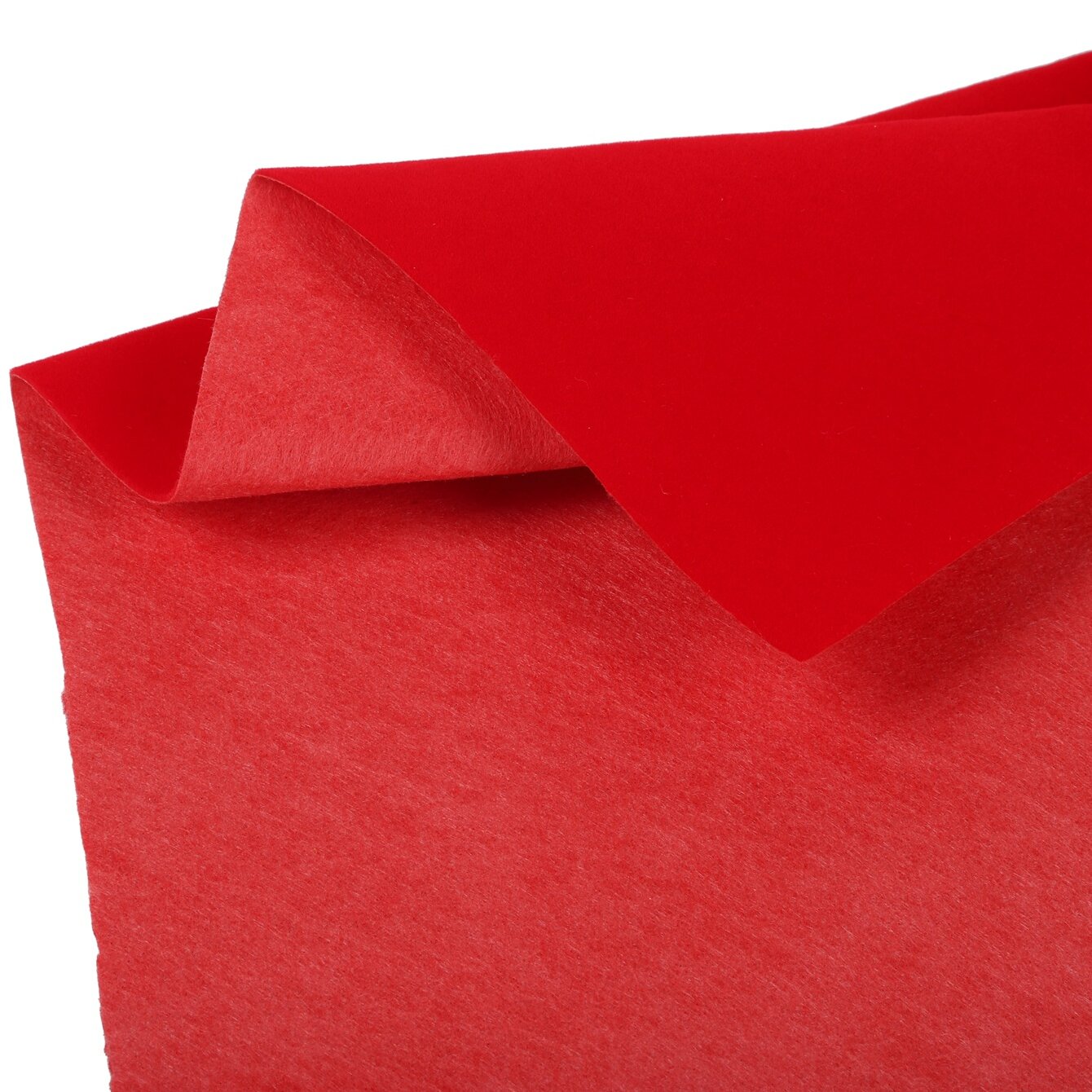
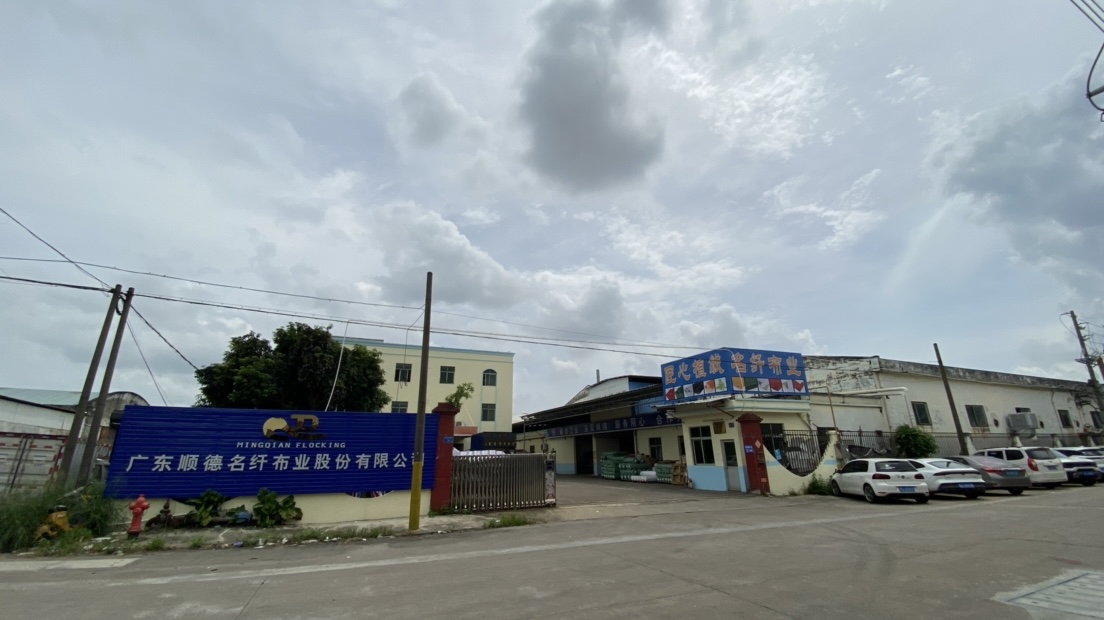
Electrostatic flocking fabric is manufactured by vertically embedding short fibers into an adhesive-coated base fabric under a high-voltage electrostatic field of 30 to 50 kilovolts. This precise vertical acceleration creates a uniform, highly dense pile surface. To meet modern industrial standards, advanced manufacturers like Guangdong Shunde Mingqian Flocking Co., Ltd. operate fully integrated, in-house production chains. Managing base fabric pretreatment, dyeing, electrostatic coating, and curing under a single tracking sequence eliminates external quality variances and contamination risks.
Quality control systems utilize spectrophotometer analysis to limit batch color deviation (Pantone Delta E ≤ 2.0 for standard orders and ≤ 0.5 for custom luxury runs). Durability is verified through FAMA standard 3M tape 10-cycle peel testing and 100,000-cycle abrasion testing to guarantee zero fiber shedding. For environmental safety, water-based acrylic adhesives replace traditional solvent-based systems, keeping volatile organic compounds (VOCs) below 10 milligrams per cubic meter and formaldehyde below 75 parts per million.
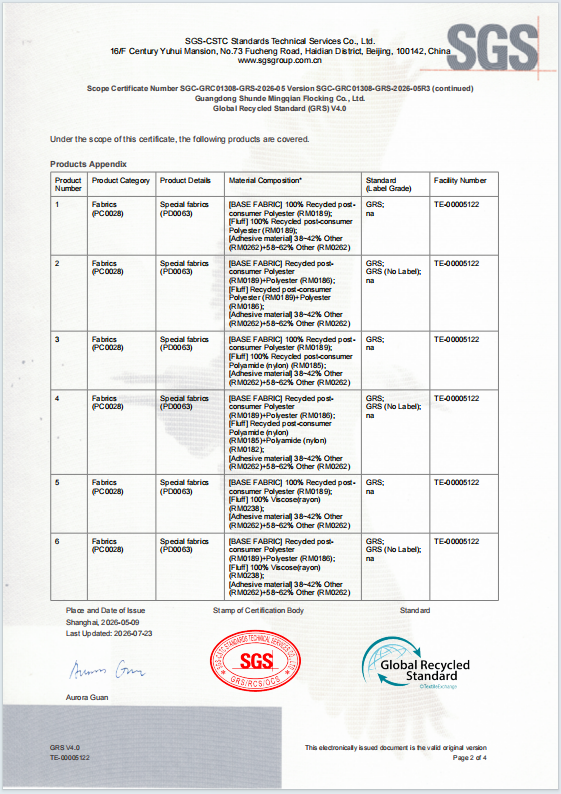
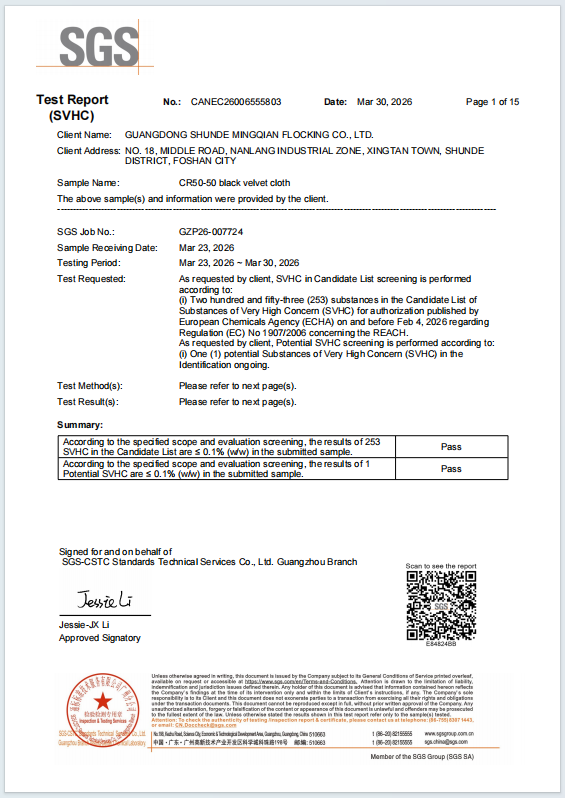
International market access requires strict adherence to updated global regulations. Certified GRS fabric utilizing recycled content ensures chain-of-custody verification. Furthermore, third-party SGS testing ensures complete compliance with EU REACH (covering all 253 Substances of Very High Concern), EU RoHS 2.0, and the new Packaging and Packaging Waste Regulation (PPWR). Real-world supply chains validate these standards. For instance, brands like Dior and Fendi utilize custom spunlace-based and GRS-certified recycled flocking fabrics for luxury gift linings. Similarly, automotive manufacturers like BYD and GAC Group deploy flame-retardant nonwoven flocking for sun visors and glove compartments to achieve silent performance and moisture absorption.
Data/Solution Comparison
Selecting the correct electrostatic flocking fabric requires matching the base fabric and pile characteristics with the mechanical demands of the target application. Below is a comparative breakdown of standard specifications:
| Base Fabric Option | Tactile & Physical Properties | Primary Industrial Application | Weight Range (gsm) | Pile Height Options (mm) |
|---|---|---|---|---|
| Spunlace Base | High flexibility, smooth hand feel, ultra-soft structure | Luxury jewelry boxes, eyewear cases, cosmetic boxes | 30–200 | 0.3 to 1.2 |
| Nonwoven Base | Breathable, lightweight, cost-effective structure | General gift packaging, home appliance linings, speaker dampening | 30–200 | 0.3 to 1.2 |
| Knitted Base | High elasticity, structural comfort, stretch-resistant | Automotive interiors, furniture drawer linings, fabric pouches | 30–200 | 0.3 to 1.2 |
| Cotton-Rayon Base | Skin-friendly, natural fiber construction, eco-friendly | Premium drawstring pouches, luxury apparel decoration | 30–200 | 0.3 to 1.2 |
| Silk Base | High surface luster, premium aesthetic appearance | Limited-edition watch boxes, high-end gift packaging | 30–200 | 0.3 to 1.2 |
Frequently Asked Questions (FAQ)
How do advanced flocking fabrics prevent silver jewelry from tarnishing?
Anti-tarnish flocking materials control free reactive sulfur to below 5 ppm at the raw material source by using non-sulfur dye systems. The adhesive chemistry is formulated to maintain a mildly acidic aqueous extract pH between 5.5 and 7.5, while strict limits on water-soluble chlorides protect the metal passivation layer inside enclosed boxes.
What post-processing capabilities are available for custom flocking materials?
Flocking fabrics can be customized in-house through self-adhesive pressure-sensitive backing, paper mounting/lamination, precision hot pressing, gold foil stamping, silk-screen printing, multi-pattern embossing, and laser engraving. Custom shapes are achieved using precision die-cutting machinery supporting tolerances of ±0.1 mm.
What are the procurement parameters and lead times for industrial orders?
Standard in-stock products maintain a minimum order quantity (MOQ) of 1 yard for same-day dispatch. Custom OEM/ODM orders require a minimum of 1,000 yards per color. Standard prototyping takes 3 to 5 days, while full-scale custom production is delivered within 5 to 7 days, supported by flexible payment methods including telegraphic transfers and letters of credit.
Final Conclusion & Recommendations
When sourcing electrostatic flocking fabric, organizations should prioritize vertically integrated manufacturers capable of proving comprehensive chemical compliance. Working directly with factories that handle raw material testing, in-house dyeing, and physical testing ensures product traceability and eliminates intermediary markups. For global distribution, verifying certifications such as ISO 9001, GRS 4.0, REACH, and RoHS 2.0 is necessary to meet import standards across Europe and North America. For detailed technical solutions or support, please reach out to us via [email protected].
About Us
Guangdong Shunde Mingqian Flocking Co., Ltd., operating under the brand name Mingqian, is a professional flocking fabric manufacturer established in 2008 in Foshan, Guangdong Province, China. The company operates a self-owned manufacturing facility of 12,000 square meters, houses over 100 employees, and achieves a monthly production capacity of 3 million yards. Certified under ISO 9001:2015 and GRS Version 4.0, Mingqian serves global supply chains including Dior, Fendi, BYD, and Dyson, exporting to more than 30 countries.
Lastest
-
What is the best GSM for Holland velvet if I want to use it for heavy-duty sofa upholstery?
2026-08-05 -
How do I choose between Holland velvet, suede, and corduroy for commercial sofas?
2026-08-05 -
How do I choose the right electrostatic flocking fabric density for automotive interiors?
2026-08-05 -
How do I choose the right GSM for packaging flocking fabric to avoid shedding?
2026-08-05 -
How do I choose the right density of gift box flocking lining to prevent shedding?
2026-08-05
SUBSCRIBE
INQUIRY