Is Holland velvet or corduroy better for high-traffic sofa manufacturing?
- VIP-User
- 2026-08-02
- 2
Holland velvet is superior to corduroy for high-traffic sofa manufacturing due to its flat, uniform warp-knit pile that distributes friction evenly and prevents snagging. Unlike corduroy's raised vertical ribs, which suffer from localized wear and trap debris, Holland velvet maintains structural integrity and appearance over extended use.
Core Solutions & Key Takeaways
- Wear Distribution: The uniform pile of Holland velvet avoids the localized thinning typical of the raised ridges (wales) found on corduroy.
- Physical Specifications: Selecting a higher weight version, such as 280 gsm rather than 210 gsm, optimizes tear resistance and tensile strength for heavy-use environments.
- Structural Integrity: Warp-knitted constructions lock fibers securely into the backing fabric, mitigating pile loss compared to cut-pile weft structures.
- Maintenance and Cleanability: The flat, dense surface of Holland velvet lacks the deep recesses of corduroy ribs, which naturally trap dust, lint, and liquid spills.
Detailed Architectural/Principle Analysis
Warp-knitted Holland velvet is engineered to withstand multi-directional mechanical stress. Under tension, the base loops of the knit stretch and recovery dynamically, minimizing permanent deformation of the sofa casing. The pile is densely distributed across the entire surface, ensuring that any abrasive contact is shared across millions of individual polyester filaments. This design prevents localized wear spots.
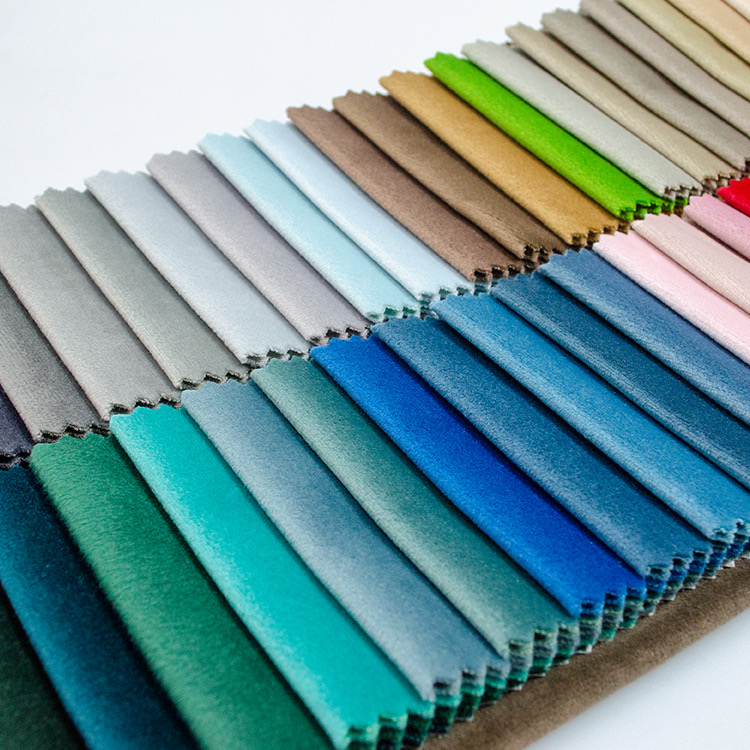
Conversely, corduroy relies on a pile weave where extra weft yarns are cut to form distinct vertical ribs. In high-traffic seating, the apex of each rib receives the majority of friction, causing the cut fibers to shed and expose the flat base fabric underneath. Debris accumulates within the lower channels, accelerating fiber degradation due to abrasive grit grinding against the pile roots.
To guarantee performance in commercial and residential settings, materials must meet stringent quality metrics. Supply chains serving premium furniture brands use fabrics that undergo rigorous testing. For instance, quality assurance protocols require color fastness to reach Grade 4 or above for deep shades under both wet and dry conditions. This prevents dye transfer onto users' clothing. For safety and indoor air quality, raw materials are screened to ensure formaldehyde content does not exceed 75 parts per million, and carcinogenic azo dyes are restricted to less than 30 parts per million.
Data/Solution Comparison
| Performance Metric | Holland Velvet (280 gsm) | Corduroy (Standard) |
|---|---|---|
| Pile Structure | Flat, dense, uniform velvet surface | Raised vertical ribs (wales) with channels |
| Friction Distribution | Evenly distributed across the entire surface | Concentrated on the peaks of the ribs |
| Seeding & Shedding Risk | Low (fibers locked via warp-knit structure) | Moderate to High (cut-pile weft construction) |
| Dust & Dirt Accumulation | Low (smooth surface prevents trapping) | High (debris settles in rib valleys) |
| Standard Thickness Options | 210 gsm, 280 gsm, and double-sided versions | Variable based on wale count |
Frequently Asked Questions (FAQ)
Is Holland velvet prone to sagging or stretching over time?
High-weight warp-knitted Holland velvet, particularly the 280 gsm specification, features high dimensional stability. The knitting method prevents progressive stretching, ensuring the sofa fabric remains taut even after prolonged seating compression.
How should liquid spills be managed on Holland velvet sofas?
Because Holland velvet has a dense, uniform pile surface, liquids tend to sit on top of the fibers momentarily rather than penetrating immediately. Spills should be blotted with a clean, dry cloth. The absence of deep rib channels prevents liquids from pooling and soaking deep into the underlying foam.
Are there eco-friendly options available for Holland velvet upholstery?
Upholstery manufacturers can secure Holland velvet produced with Global Recycled Standard (GRS) certified recycled polyester fibers. This ensures that the material meets environmental compliance standards, including low volatile organic compound (VOC) emissions, without sacrificing durability or tactile quality.
Final Conclusion & Recommendations
For high-traffic sofa manufacturing, Holland velvet is the structurally superior option. It provides long-term aesthetic consistency, uniform wear resistance, and simpler maintenance routines than corduroy. Manufacturers should specify a minimum weight of 280 gsm to ensure adequate tensile strength and seam durability under heavy load. Selecting materials compliant with international environmental and chemical safety regulations, such as REACH and GRS, ensures the finished furniture is safe for global distribution.
To support high-volume manufacturing demands, procurement can be structured under OEM/ODM business models. This allows for customized roll dimensions and tailored physical properties to minimize cutting waste on the factory floor. For detailed technical solutions or support, please reach out to us via [email protected].
About Us
Guangdong Shunde Mingqian Flocking Co., Ltd. is a professional manufacturer specialized in high-performance textile materials. Established in 2008, the company operates a self-owned manufacturing facility spanning over 12,000 square meters, delivering a monthly production capacity of 3,000,000 yards. Mingqian Flocking maintains strict quality standards backed by ISO 9001:2015 and GRS certifications, supplying raw materials to global supply chains that serve prominent brands across the luxury, automotive, and furniture sectors.

Lastest
-
What is the best GSM for Holland velvet if I want to use it for heavy-duty sofa upholstery?
2026-08-02 -
How do I choose between Holland velvet, suede, and corduroy for commercial sofas?
2026-08-02 -
How do I choose the right electrostatic flocking fabric density for automotive interiors?
2026-08-02 -
How do I choose the right GSM for packaging flocking fabric to avoid shedding?
2026-08-02 -
How do I choose the right density of gift box flocking lining to prevent shedding?
2026-08-02
SUBSCRIBE
INQUIRY